26 August 2026
Silkroad Online never died — it just moved house
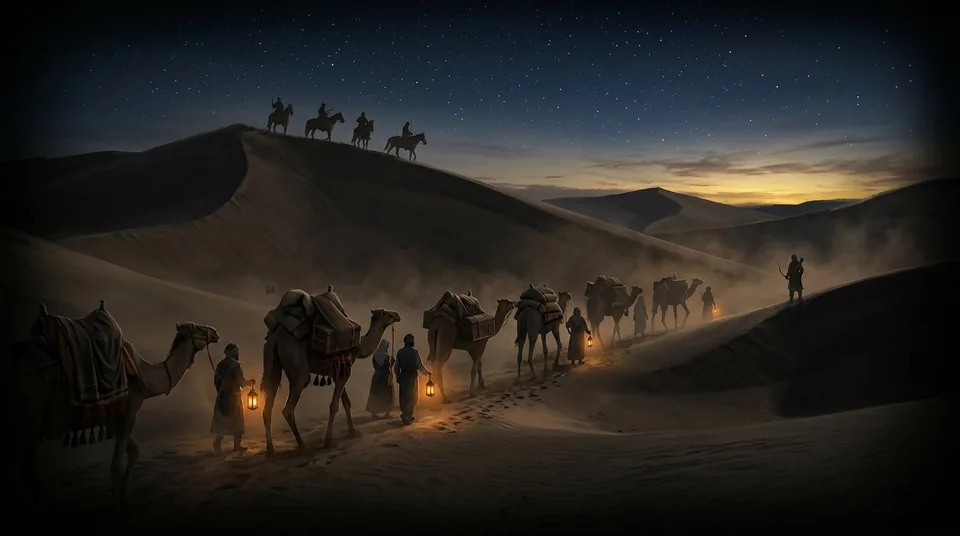
There is a walk in Silkroad Online that thousands of people still remember step for step. You leave Jangan through the west gate with a camel loaded with specialty goods, take the road past the bandit archers, cross the ferry at Donwhang, and push out into the Taklamakan with the trade window open and your heart rate slightly elevated — because somewhere out there, somebody is wearing the black suit.
That walk is twenty years old. People are still doing it tonight.
The triangle
Silkroad's job system is the best player-versus-player design nobody talks about. Three roles, and each one exists only because of the other two. Traders buy goods in one city and sell them in another; profit scales with distance, so the money is literally on the road. Thieves level by killing traders and fencing the stolen goods. Hunters get paid to walk beside the caravan and kill thieves. No queue, no arena, no matchmaking — just an economy where every profitable action creates a target on your back, and every target creates a job for somebody else.
A max-star trade run was a genuine event. You'd gather the guild, hire hunters you half-trusted, check the thief kill board for who was online, and set off knowing the run could end with your goods on a stranger's camel. Modern MMOs patched this kind of risk out of existence. Silkroad players never stopped missing it, because nothing since has made a camel feel like a high-stakes bet.
The grind that raised us
Silkroad asked for an absurd amount of your life and we handed it over happily. The gap — deliberately keeping your weapon mastery levels below your character level to farm skill points — was a rite of passage that turned leveling into a second job. Eight-man parties grinding bandits at the stronghold until the spawn timer lived in your dreams. Ongs in the desert. The penon cave. Saving for a stall pet, for an elixir stack, for one more alchemy attempt at +7 while the whole server held its breath — the glow was worth the tears. A Seal of Sun drop could make your month. A unique spawn — Tiger Girl, Isyutaru, Lord Yarkan — turned a hundred strangers into a single screaming mob, and fortress war on Sundays turned guilds into families with grudges.
It wasn't content in the modern sense. It was a place. You knew the roads, the prices, the thieves by name.
What killed the official game
Not the players. Joymax let the bots eat the world — gold-bot trains ten deep streaming out of town at spawn, more automated characters than humans on some realms — and the item mall crept from convenience into pay-to-win while tickets went unanswered. When the European race and the later expansions arrived, they added content but diluted the triangle, piling systems on top of the one thing that made the game itself. People didn't leave Silkroad. Silkroad left them, one patch at a time.
The house it moved into
When the vSRO server files leaked in the early 2010s, they seeded an entire private scene — and that scene decided, almost unanimously, what the real game was: cap 110, degree 11. The era before the bloat, when the triangle still ruled and a Sun weapon still meant something. Fifteen years later that consensus still holds. Cap-110 openings in 2026 pull thousands of concurrent players and Discords the size of small towns, and projects like Electus have been running continuously for over a decade — longer than most retail MMOs live.
And here's the thing the English-speaking games press never understood: Silkroad was never really a Western game. It was Turkish and Arabic and Vietnamese and German and a dozen other scenes that treated it as the MMO. The private servers reflect that — half the launch announcements aren't in English, and the player counts don't care.
Why people still play
Because the triangle is still unmatched. Because an economy where a full camel makes you a target produces stories, and stories are what people actually log in for. Because the grind respected your time by demanding all of it — and what it gave back was a server where your name meant something, where the guy who robbed you in 2009 is in your Discord, still laughing about it.
Silkroad didn't survive on nostalgia. It survived because nobody ever built a better road.
If that's the itch you have, the Silkroad listings here are ranked by the people still walking it. Some of them have been trading since before some of our readers were born. They'll still be there tomorrow, camels loaded, watching the dunes.